Titan Rope Hero: Vice City
- 4.3
- Rating
- 1.00M
- Installs
- Free
- Price
 Analysis by App-foxy
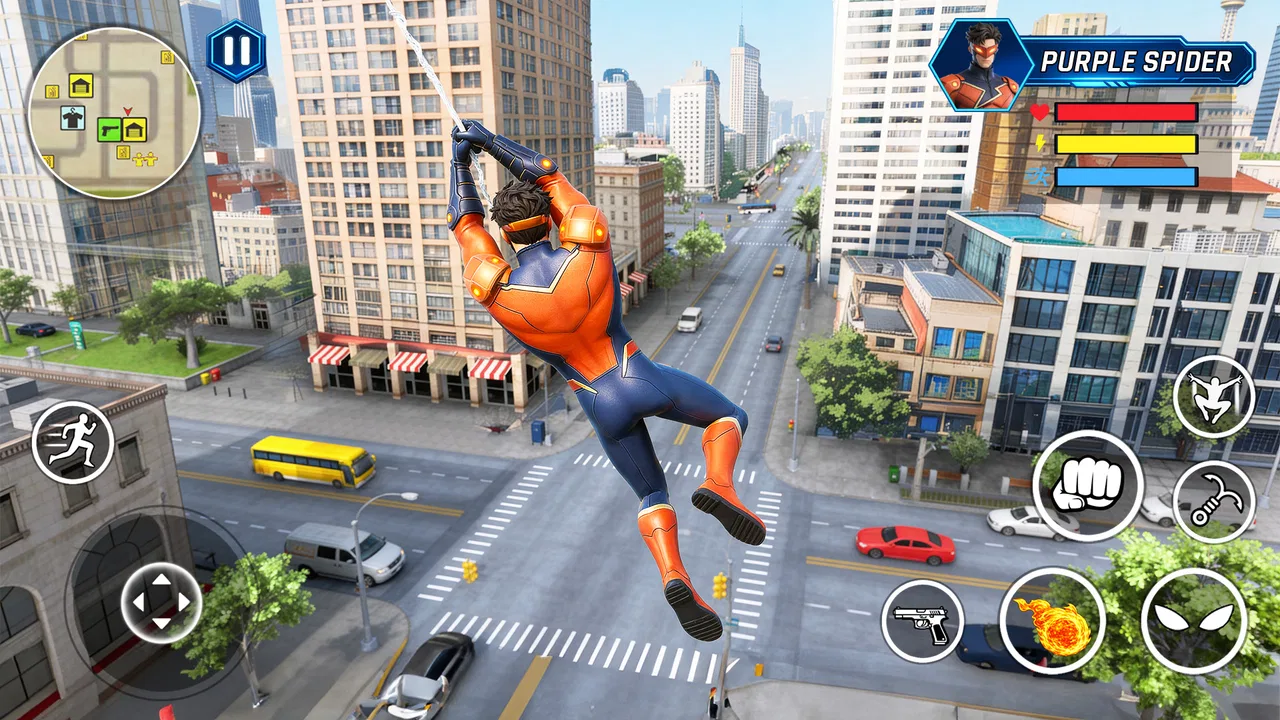
My first few minutes with Titan Rope Hero: Vice City gave me a clear impression of what kind of action game this is. It wants movement to feel dramatic, with a powerful hero crossing a city by rope and meeting trouble head-on rather than slowly exploring every corner. The central appeal is immediate: swing through an urban setting, land with impact, and turn travel into part of the action instead of treating it as empty space between missions.
That straightforward idea is also the game’s biggest strength. I do not need a long tutorial or a complicated backstory to understand the fantasy. I am here to feel larger than ordinary street-level characters, move quickly through Vice City, and use that momentum when fights begin. The result is best enjoyed in short sessions, especially when I want something more physical and direct than a strategy game or a slow role-playing adventure.
The game is a free action title from SKYVERTY COMPANY LIMITED, aimed at an Everyone audience. It has reached over a million installs and holds a 4.3 average from around 1.4 thousand ratings, which suggests that the simple rope-hero premise has found a sizeable audience. I see the appeal: the concept is easy to understand, and the setting gives ordinary movement a bit of spectacle.
You May Also Like

 Blood Strike: 2.5 Anniversary
Blood Strike’s Loadouts Turn Every Drop Into a Tactical Gamble
A close look at Blood Strike’s custom loadouts: how fast access to signature weapons reshapes its battle royale rhythm, rewards preparation, and narrows the gap between fights.

 Pandora - Music & Podcasts
Pandora’s Music Is Easy to Start, but Harder to Recover
Pandora’s strength is its low-effort path from a seed to a station. Its weak spot is how much confidence it asks you to place in connection, setup, and quiet recovery.

 8 Ball Pool
 Is Built on Rivalries, Rematches, and Routine
A close look at the rivalries, rematches, shared routines, and unanswered safety questions that turn a quick pool match into a persistent mobile community.

 Samsung Music
’s Quiet Strength Is Playing What You Already Own
Its reach comes less from spectacle than from dependable access to a personal library. That simplicity is both the app’s strongest retention engine and its ceiling.

 AccuWeather: Weather Radar
AccuWeather Review: A Quick, Clear Forecast for Everyday Decisions
For everyday plans, the best forecast is the one you can understand quickly. AccuWeather makes rain timing, radar, and local conditions easy to act on, with a few trade-offs.

 Hill Climb Racing
Why Hill Climb Racing Still Turns Crashes Into One More Run
A tiny car, a bumpy hill and one more upgrade: Hill Climb Racing keeps resurfacing because its simple chaos makes every near-miss feel personal.
More From Our News Desk
View All News


How Vice City turns movement into the main attraction
I find that the most satisfying way to approach this game is to make each swing a choice, not just a shortcut: pick a landing point, then decide how to enter the next encounter. That small habit gives the city a practical role and makes movement feel more deliberate. It also sets up the next section’s focus on how the setting shapes the action.
A city built for a larger-than-life mood
Vice City works less as a quiet place to study and more as a stage for exaggerated action. The urban backdrop gives the hero a useful contrast. Streets, buildings, and open routes make the rope movement feel meaningful because I am not merely jumping inside a small arena. I am crossing a place that suggests scale, speed, and danger, even when the immediate task is simply getting from one point to another.
The art direction supports that fantasy by keeping attention on the silhouette of a powerful character moving through a recognizable city-like environment. A rope swing is visually readable in a way that a complicated traversal system may not be. I can understand the intended line of motion quickly, and that clarity matters when the game asks me to react while moving rather than stop and plan every action.
One useful way to approach the setting is to treat the skyline as a navigation tool. Instead of looking only at the ground, I pay attention to tall surfaces and open gaps that can support a faster route. This changes the city from background decoration into a practical part of play. The best moments come when I choose a route because it looks fun and efficient, not simply because it is the safest path.
That freedom has a trade-off. A city designed around movement can sometimes feel less detailed than a world built for investigation, conversation, or slow discovery. I would not choose this game expecting the environmental storytelling of a narrative adventure. Its location is most successful when I use it as a playground for momentum and combat positioning.
Why the visual language matters during combat
The hero’s larger-than-life presentation helps me understand the intended combat rhythm. I am not playing as a fragile survivor who should avoid every confrontation. I am playing as a force that can enter a situation aggressively, reposition, and keep the action moving. That tone makes even basic encounters feel more energetic because movement and fighting belong to the same fantasy.
My practical advice is to avoid treating the rope only as transportation. Using it to approach a fight, escape a crowded area, or change the angle of an attack makes the system feel more connected. If I simply walk everywhere and use combat in isolation, the game loses some of its identity. The rope is the feature that separates this experience from a standard street-fighting game.
There is also a pacing benefit. Long movement sequences can provide a short breathing space after a confrontation, while a sudden arrival near danger can make the next encounter feel more urgent. The city therefore helps divide the experience into small bursts: travel, approach, clash, recover, and move again. That loop is easy to pick up when I have only a few minutes available.
Sound as a guide for the game’s energy
The sound design is most useful when it reinforces motion and impact. In a game centered on swinging and fighting, audio needs to make transitions feel connected: launching into movement, reaching a destination, and entering a confrontation should not feel like unrelated actions. When those moments flow together, the city feels more active even if I am focusing mainly on the next objective.
I found that the game’s mood works better when I let the action breathe instead of rushing every input. A brief pause before a swing can help me judge the route, and a controlled approach can make the landing feel more deliberate. The sound and visual rhythm then support a simple pattern of anticipation followed by impact. That is more satisfying than holding movement continuously and hoping the character arrives in the right place.
Sound also affects whether repeated sessions become tiring. The premise is naturally loud and energetic, so players who prefer calm exploration may find the presentation intense over time. I would use a lower volume when playing casually or when I want to focus on navigation. The game’s atmosphere is strongest when the audio adds weight to the action without becoming the only source of excitement.
Where the mechanics fit the presentation
The rope movement is the mechanical center because it gives the character a distinctive way to inhabit the city. It is not just a cosmetic power. It changes how I read distance, height, and approach. A normal action game might make me follow streets toward a fight; here, I can think in terms of lines through the environment. That difference gives the game its own reason to exist.
For better control, I recommend separating travel decisions from attack decisions. First, I choose where I want to arrive. Then I think about how to enter the encounter. Trying to improvise both at exactly the same moment can make a simple situation feel messy. This two-step habit is especially helpful when the city offers several possible routes and I am tempted to swing without checking the landing area.
Another useful habit is to preserve an escape route. Because the hero can move through the city in an unusual way, I do not always need to stand in the center of a fight. I can engage, create distance, and return from a better angle. That approach makes the traversal system part of survival rather than a decorative trick. It also keeps the action from becoming a repetitive exchange of attacks at ground level.
The game is easier to appreciate when I accept that it favors immediacy over deep simulation. I am not looking for a detailed superhero role-playing system with layers of character management. I am looking for an accessible action loop where movement itself supplies the spectacle. Players who want a large collection of abilities, careful build planning, or highly technical combat may find the design too direct.
How it compares with familiar action alternatives
Compared with a conventional open-city action game, this title puts more emphasis on the fantasy of being a mobile powerhouse. The difference is not necessarily the size of the world; it is the way I am encouraged to cross it. In a typical alternative, driving or walking may dominate travel, while here the rope gives movement a more theatrical quality and lets me think vertically.
Compared with a side-scrolling action game, the city provides a stronger sense of direction and personal space. I am not limited to a narrow lane of enemies and platforms. At the same time, the trade-off is that a broader environment can make navigation less precise. Players who enjoy clearly staged encounters may prefer a more linear action game, while players who like choosing their own approach will probably get more from Vice City.
It also differs from story-heavy superhero games. Those games often ask me to follow character arcs, investigate locations, and absorb a carefully paced narrative. This one is better suited to a player who wants the physical fantasy first. I can recommend it to someone who wants to swing into action without committing to a long cinematic campaign. I would not recommend it as a substitute for a narrative-focused superhero adventure.
Everyday use: short sessions and quick action
A realistic use case is a short break when I want something active but do not want to learn a complicated system. I can start with a simple goal: cross part of the city, test a route, and handle whatever confrontation appears along the way. The session still feels complete even if I do not play for a long stretch, because movement and combat provide their own small arc.
For a longer session, I would vary the way I travel rather than repeat the fastest route every time. One attempt can focus on speed, another on approaching fights from above or from the side, and another on simply learning how the city connects. This self-imposed variety helps prevent the core loop from feeling too mechanical. It also turns the environment into something I actively experiment with instead of merely passing through.
The game’s Everyone rating makes it broadly approachable from a content standpoint, but accessibility of theme is not the same as universal preference. Younger or casual players may enjoy the clear hero fantasy, while people who dislike action, rapid movement, or repeated combat should probably choose a calmer genre. The simple controls may be welcoming, but the pace can still feel busy when several decisions arrive together.
What to expect from the current release
The current version is 1.0.5, and the game is available at no cost. It supports devices running Android 7.0 or later, so compatibility should be considered before installing, particularly on an older phone or tablet. I would also make sure the device has enough free space and that the controls feel comfortable on the screen before judging the game’s longer-term appeal.
The free entry point is important because it makes experimentation easy. I can try the movement, see whether the city’s rhythm suits me, and decide quickly whether the action loop is worth returning to. That is a better fit for this kind of immediate game than a product that demands a large commitment before revealing its central idea.
At the same time, free access does not remove the design trade-offs. If I want deep progression, a strongly written campaign, or a carefully balanced competitive experience, the basic rope-hero structure may not satisfy me for long. Its value comes from quick, accessible action and the pleasure of controlling a powerful character in an urban playground.
Who should play it and who should skip it
I would recommend it to players who enjoy superhero-style movement, simple action, and city settings that are meant to be crossed rather than studied. It is especially suitable for someone who likes the feeling of swinging toward trouble, arriving with momentum, and using mobility to keep an encounter lively. The game also makes sense for casual players who want a free experience they can understand quickly.
I would suggest skipping it if your priority is a rich story, realistic physics, intricate progression, or carefully choreographed level design. The rope fantasy is the reason to play, but it can also expose the game’s limits: once the novelty of swinging and fighting fades, players may need to create their own variety through route choices and movement experiments.
My strongest tip is to judge the game by its complete loop rather than by one isolated fight. Spend time moving through the city, try different approaches, and notice whether the transition from travel to combat feels satisfying. If that connection works for you, the straightforward design becomes a strength. If it does not, no amount of extra fighting will make the experience feel deeper than it is.
Atmosphere verdict
What stays with me is the way the setting, movement, and action aim at one coherent mood: bold, fast, and slightly theatrical. Vice City is not merely a backdrop, the rope is not merely a special effect, and combat is not entirely separate from travel. Each part supports the fantasy of a hero who can turn the city’s spaces into routes and use momentum to control the encounter.
The best reason to try Titan Rope Hero: Vice City is the feeling of making the city part of the action. When I swing with a destination in mind, arrive cleanly, and keep moving after the clash, the game has a satisfying identity that ordinary action alternatives do not quite offer.
My final opinion is positive but specific. I see this as a free, approachable action game for short bursts of urban superhero play, not as a replacement for a deep open-world adventure or a story-led campaign. The 4.3 average and over a million installs show that its accessible premise has broad appeal, while the real test is personal: if swinging through a city and fighting as a powerful hero sounds more appealing than managing complex systems, this is an easy game to sample. I would recommend giving it a fair session focused on movement, because that is where its art direction, sound, pacing, and mechanics come together most clearly.
FAQs for Titan Rope Hero: Vice City
01What is Titan Rope Hero: Vice City about?
Titan Rope Hero: Vice City is an open-world action game in which you control a superpowered hero exploring a crime-filled city. The character can swing between buildings with a rope, fight enemies, drive vehicles, use special abilities, and complete missions. It combines superhero movement with a sandbox crime-game structure, so players can follow objectives or simply explore the city and experiment with the available powers.
02Can I play Titan Rope Hero: Vice City offline?
The game is generally designed to be playable without a constant internet connection, which makes it convenient for offline sessions. However, some features may behave differently depending on the version installed, including advertisements, updates, analytics, or optional online services. It is recommended to launch the game once while connected to the internet, then test offline mode before relying on it during travel or in areas with limited connectivity.
03Is Titan Rope Hero: Vice City free to download?
Titan Rope Hero: Vice City is typically offered as a free download, allowing players to install the main game without paying upfront. Free access may be supported by advertising, and certain versions can include optional purchases or promotional content. Before installing, check the store listing for the current monetization details, required permissions, file size, and any device-specific conditions that could affect the overall experience.
04What devices are compatible with Titan Rope Hero: Vice City?
Compatibility depends on the operating system, device model, and the specific version available in the app store. Because the game features a 3D open-world environment, older phones may experience slower loading, reduced frame rates, or occasional crashes. Make sure your device has enough free storage, an updated operating system, and sufficient memory. Closing background apps can also improve performance during gameplay.
05Is Titan Rope Hero: Vice City suitable for children?
The game is better suited to teenagers and older players because it includes superhero combat, criminal missions, vehicle destruction, weapons, and action-oriented violence. It may also display advertisements or contain content that parents prefer to supervise. Families should review the age rating shown in their regional app store and consider enabling parental controls, especially if the device is shared or in-app purchases are available.
Pros
- Large open-world city to explore freely
- Many superhero abilities and vehicles to experiment with
- Simple controls make the game easy to pick up
- Action missions provide quick
- casual entertainment
- Playable offline after installation
Cons
- Frequent ads can interrupt gameplay
- Graphics look dated on newer devices
- Repetitive missions may reduce long-term appeal
- Some vehicles and upgrades require in-app purchases
- Performance may suffer on budget smartphones

Titan Rope Hero: Vice City
Gallery